Can calprotectin and lactoferrin tests be positive without IBD?

Yes. Positive calprotectin and lactoferrin results can occur without IBD, including during gastrointestinal infections. They suggest bowel inflammation, but cannot confirm Crohn’s disease or ulcerative colitis by themselves.
That's why it's always important to confirm your results and look at them in clinical context, rather than assume you already have a lifelong condition. It's always best to investigate the cause of raised lactoferrin alongside symptoms and other findings.
What does it mean if calprotectin and lactoferrin are positive?
It means the sample tested contains these inflammation markers at or above the test’s cut-off. Calprotectin and lactoferrin are proteins associated with white blood cells involved in gut inflammation.
Two positive markers add evidence that inflammation may be present. The same infection can raise both; they don’t give you two separate confirmations of IBD.
The wording matters. A laboratory may report a measured calprotectin concentration in micrograms per gram of stool, written as µg/g. A qualitative rapid test reports positive or negative, without showing exactly how high the level is.
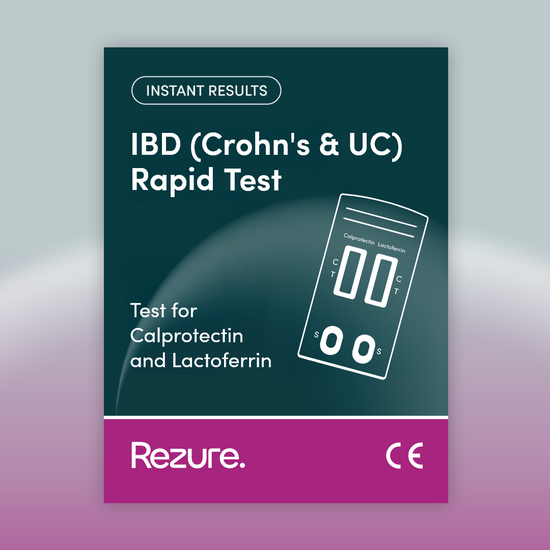
The professional-use IBD (Crohn's & UC) Rapid Health Test Rezure sells checks these markers. Its stated calprotectin detection threshold is 50 µg/g. A positive result therefore cannot tell you how far above that threshold your sample sits.
These markers also answer a different question from tests for inflammation and hidden blood.
Can you have high calprotectin without IBD?
Yes. High calprotectin without IBD can reflect inflammation caused by another bowel condition. It doesn’t necessarily mean the test has made a mistake.

Possible explanations your clinician may consider include:
- Gastrointestinal infections. Infectious diarrhoea can raise calprotectin. Recent illness, travel or antibiotic treatment may change which infection tests your clinician requests. Tell your GP about diarrhoea after antibiotics, because Clostridioides difficile, often shortened to C. diff, is one possible cause.
- Diverticulitis. Small pouches can develop in the bowel wall. When they become inflamed or infected, the condition is called diverticulitis. It can raise calprotectin, and doctors assess it differently from Crohn’s or ulcerative colitis.
- Coeliac disease. Raised stool markers can occur in some cases. They aren’t reliable tests for diagnosing coeliac disease, so a clinician may arrange separate antibody blood tests. Years of eating gluten without obvious problems don’t exclude it: coeliac disease can start later.
- Other bowel disease. Some cancerous and non-cancerous bowel tumours can also raise calprotectin. This is one reason clinicians consider age, bleeding, weight loss and other findings instead of treating the result as an IBD diagnosis. The marker alone cannot diagnose cancer.
The NHS laboratory guidance lists infections, coeliac disease, diverticulitis and malignancy among alternative causes.
And IBS? It generally doesn’t cause the bowel inflammation these tests assess. If you already have an IBS diagnosis, a raised marker needs interpretation rather than automatic attribution to IBS.
What causes positive lactoferrin in stool?
Positive faecal lactoferrin suggests intestinal inflammation involving neutrophils, a type of white blood cell. IBD is one possible explanation. Infections, including C. diff, and other bowel conditions can produce the same signal.

Finding the source takes more than another inflammation marker.
Depending on your symptoms, your clinician may:
- Review your history. Explain when symptoms started, recent travel, antibiotic use, other medicines and any previous bowel diagnosis.
- Check for infection. Stool tests can look for organisms causing diarrhoea. Lactoferrin itself doesn’t identify the organism.
- Arrange blood tests. These may check for anaemia, inflammation or coeliac antibodies.
- Request specialist assessment. Persistent unexplained inflammation may need endoscopy, biopsies or imaging.
Diagnostic investigations vary between patients. You won’t necessarily need every test listed.
This is a more focused question than assessing the conditions that can resemble IBS: there’s now an abnormal result to explain.
What can falsely elevate calprotectin?
A calprotectin false positive for IBD can actually be a correct measurement of inflammation from another cause. An infection raising calprotectin is an example. The misleading part is assuming that raised calprotectin must mean IBD.
Medicines deserve a closer look.
NSAIDs, including ibuprofen, naproxen and diclofenac, can affect results and may cause bowel inflammation. Acid-suppressing medicines called proton pump inhibitors, such as omeprazole, can also raise calprotectin.
In a small randomised clinical trial involving 32 healthy volunteers, 53% had calprotectin above the normal range while taking omeprazole. That doesn’t predict your result, but it demonstrates why medication history matters.
Calprotectin isn’t spread evenly through stool, so results can vary between samples. A changed result doesn’t automatically mean the first test was wrong.
Sample collection and handling also matter. Follow the instructions for your particular test.

Don’t stop prescribed medicine yourself. Ask your clinician if a supervised change and repeat test would help, and how long to wait. A plausible medicine effect should not delay assessment of concerning symptoms.
When should you worry about high calprotectin?
Your symptoms affect urgency, alongside the measured level and other test results. A positive rapid test alone doesn’t tell you that you need emergency care.
Book a review of an unexplained positive result, even if you feel reasonably well. Report weight loss, persistent bowel changes or night-time symptoms. Some overlap with the early signs of Crohn’s disease, although the cause still needs investigation.
Get help sooner for these symptoms:
- Contact an urgent GP service or NHS 111 for bloody diarrhoea, black or dark red stool, or diarrhoea during or after antibiotics.
- Call 999 or go to A&E for sudden severe abdominal pain, non-stop rectal bleeding or a large amount of blood.
The NHS advice on rectal bleeding and diarrhoea sets out these urgent warning signs. Don’t wait for a repeat stool test.
Does high calprotectin mean you need a colonoscopy?
Not automatically. Your clinician considers symptoms, the result’s size and persistence, infection testing and your risk factors.
For example, the North Midlands guidance describes laboratory results of 100 to 250 µg/g as mildly raised or equivocal. Its guidance suggests repeat testing after 2 to 4 weeks when assessing possible IBD, with referral if the result stays raised. These are local instructions, not universal rules for every patient or test. You can’t place a rapid positive into these numerical bands without a quantitative result.
A colonoscopy lets a specialist examine the bowel lining and take biopsies. Persistent inflammation or concerning symptoms may make that useful. If cancer is suspected, clinicians follow the appropriate investigation pathway rather than using repeat calprotectin as a gatekeeper; NICE guidance limits this IBD-versus-IBS testing approach to people in whom cancer is not suspected.
What is the treatment for a positive lactoferrin stool result?
Treatment depends on the underlying cause. There’s no single medicine for a positive lactoferrin result.
An infection may need fluids and, for certain organisms such as C. diff, specific antibiotics. A medicine-related problem may need a supervised prescription change. Confirmed IBD requires a treatment plan from the clinical team.
Coeliac disease calls for a gluten-free diet after diagnosis. If your clinician is still testing for coeliac disease, don’t cut out gluten beforehand unless they advise you to. The NHS testing advice explains that avoiding gluten can make the results inaccurate.