Crohn’s disease symptoms: What are the early signs?

Your first clue might not feel medical; it might be a small bit of planning. You might start checking where you’ll be able to find toilets before you leave the house, or think twice before eating out. It’s easy to blame coffee, stress, a takeaway, or a busy week, and sometimes that is all it is.
When the same pattern keeps returning, though, it is worth asking a better question: is this just an upset stomach, or could it be one of the early signs of Crohn’s disease?
Crohn’s is a long-term inflammatory bowel disease. The NHS lists diarrhoea, blood or mucus in poo, stomach pain, tiredness, weight loss and flare-ups among the symptoms that can appear. This guide explains what Crohn’s symptoms can look like early on, how a stool test for Crohn’s disease fits into checking, and why a diagnosis needs more than one result.
What are the early signs of Crohn’s disease?
The early signs of Crohn’s disease often involve repeated gut changes, especially diarrhoea, stomach pain, blood or mucus in stool, tiredness, weight loss and symptoms that come and go.

Common Crohn’s disease symptoms include:
-
Diarrhoea that keeps returning
-
Cramping or stomach pain
-
Blood or mucus in your poo
-
Feeling very tired or generally unwell
-
Loss of appetite or weight
-
Flare-ups followed by calmer periods
These symptoms can overlap with IBS, infections, coeliac disease, ulcerative colitis and other gut problems. That is why the pattern matters. One bad day is different from weeks of urgent diarrhoea, pain and fatigue.
Does diarrhoea or stomach pain always mean Crohn’s?
No. Diarrhoea and stomach pain are common and usually do not mean Crohn’s. They become more concerning when they persist, recur as flare-ups, or present with blood, mucus, weight loss, or fatigue.
Crohn’s can cause watery diarrhoea because inflammation affects the bowel. Some people also get urgency. You leave later than planned. You avoid long bus rides. You learn which cafés have toilets.
Diarrhoea or stomach pain can also come from:
-
A short-term stomach infection
-
Food poisoning
-
IBS
-
Antibiotics or other medicines
-
Food intolerance
-
Coeliac disease
If upper stomach discomfort, nausea or burning pain is the main issue, a separate concern such as H. pylori may fit better than IBD. Rezure offers a stomach ulcer test for that type of question.
Can blood, mucus, fatigue or weight loss be early signs?
Yes. Blood, mucus, fatigue and weight loss can all be part of Crohn’s disease symptoms, especially when they appear alongside diarrhoea or stomach pain.

Blood may look bright red, darker red, or mixed into diarrhoea. Mucus can look clear, white or yellowish. In Crohn’s, these changes may happen because inflammation irritates the bowel lining. Get urgent advice if your poo is black or dark red, or if you have bloody diarrhoea. The NHS advice is clear on that point.
Fatigue and weight loss can happen when inflammation affects appetite, digestion, nutrient absorption and general well-being. Still, tiredness has many possible causes.
What are Crohn’s flare-ups?
A Crohn’s flare-up is a period when symptoms become active or worse. It may last days, weeks or longer.
Crohn’s often moves between flare-ups and quieter periods called remission. During a flare-up, symptoms might include diarrhoea, stomach pain, fatigue, blood or mucus in stool, low appetite and weight loss. Between flare-ups, symptoms may ease.
A short symptom diary can help your GP see the pattern. Track:
-
How often you have diarrhoea
-
Where the pain sits
-
Blood, mucus or night-time symptoms
-
Weight change
-
Feverishness or fatigue
-
Food, stress or medicine changes
Can you test for Crohn’s disease at home?
You can test for markers linked to bowel inflammation at home, but you cannot diagnose Crohn’s disease at home.
A Crohn’s disease stool test usually means a stool test that looks for inflammation markers. Faecal calprotectin is one of the best-known markers. Calprotectin is released by white blood cells during gut inflammation, and a calprotectin test can help distinguish inflammatory bowel disease from non-inflammatory conditions such as IBS.

A high result does not prove Crohn’s, and a low result does not rule it out in every case. In simple terms, calprotectin Crohn’s disease testing can show inflammation, not the exact cause.
Lactoferrin works in a similar area. It is another protein linked to white blood cells and gut inflammation. A faecal lactoferrin result can help show that inflammation or infection may need further assessment. A lactoferrin test is not the final answer by itself.
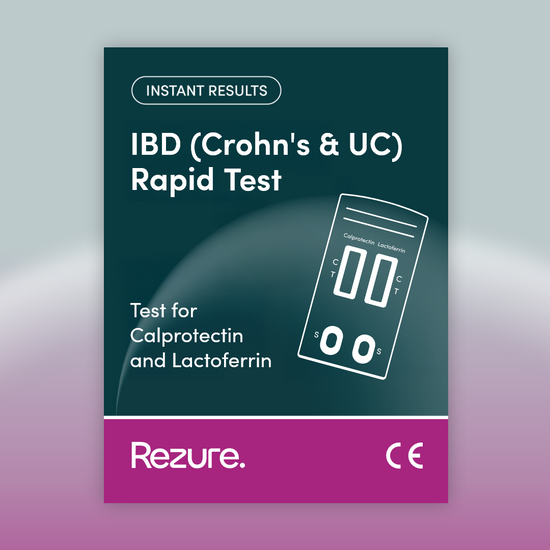
The professional IBD (Crohn's & UC) Rapid Health Test Rezure sells checks for calprotectin and lactoferrin in a stool sample. It is designed as a quick screen for markers associated with bowel inflammation, including inflammation linked to Crohn’s and ulcerative colitis. Treat it as a first-step clue, not as a diagnosis.
People sometimes confuse inflammation-based stool checks with blood-based stool checks. Rezure’s guide to different stool tests explains the gap between IBD stool markers and FOB testing.
How is Crohn’s disease diagnosed?
Crohn’s disease diagnosis usually involves symptoms, blood tests, stool tests, specialist review, endoscopy, biopsy, and sometimes imaging.
There is no single test to diagnose Crohn’s disease. If a GP thinks Crohn’s is possible, they may arrange blood tests and stool tests first. You may then be referred for colonoscopy, endoscopy, biopsy, MRI, CT or ultrasound.

So, how is Crohn’s disease diagnosed in practice? Doctors build the answer from several pieces:
-
Your symptom pattern
-
Blood markers of inflammation or anaemia
-
Stool tests for infection and inflammation
-
Faecal calprotectin results
-
Endoscopy findings
-
Biopsy results
-
Imaging, if needed
The NICE guidance supports faecal calprotectin testing to help distinguish inflammatory bowel disease from IBS when specialist assessment is being considered. Crohn’s & Colitis UK also explains that raised faecal calprotectin can suggest further checks are needed, while lower levels may point towards IBS or another non-inflammatory issue.
That is the clearest answer to how to test for Crohn’s disease. Start with symptoms. Look for inflammation. Rule out other causes. Confirm with specialist tests.
When should you speak to a GP?
Speak to a GP if you think you could have Crohn’s disease, especially if gut symptoms keep coming back or affect your normal routine.
Do not wait for symptoms to feel severe. Crohn’s can start quietly, and bowel problems without symptoms can happen in other bowel contexts, too.
Book medical advice if you have diarrhoea that does not settle, repeated stomach pain, blood or mucus in your poo, unexplained weight loss, ongoing fatigue with gut symptoms, night-time symptoms, or flare-ups that come and go.

Seek urgent help if you have black or dark red poo, bloody diarrhoea, severe pain, dehydration, fainting, or rapid worsening.
The toilet map test is not medical, but it is useful. If your gut has started planning your day for you, listen to that change. A stool test can give you one part of the picture. A proper Crohn’s disease diagnosis needs a wider view.