Family history of heart disease: When should you start checking your cholesterol?

Family health history often arrives in scraps. Your dad had a heart attack at 54. Your sister started statins in her 30s. You know there is “high cholesterol” somewhere in the family, but nobody is quite sure who was diagnosed with what.
Those details matter. Familial hypercholesterolaemia can cause high LDL cholesterol from birth. If early heart disease or high cholesterol runs in your family, waiting until a routine midlife check may mean waiting longer than you should.
When should you check cholesterol if heart disease runs in your family?
If a parent, sibling or child had a coronary event before age 60, ask your GP about cholesterol testing now rather than assuming you should wait until your 40s. NICE uses a coronary event before 60 in a first-degree relative as part of identifying people who may have familial hypercholesterolaemia. The standard NHS Health Check targets eligible adults aged 40 to 74.
High cholesterol usually causes no symptoms, so feeling fit does not tell you what your level is.
Family details worth taking to your GP include:
- The age a parent or sibling developed coronary heart disease or had a heart attack
- Any known diagnosis of familial hypercholesterolaemia
- Relatives with very high cholesterol
- Your own previous cholesterol results
If a parent has confirmed FH, NICE says children at risk should be offered diagnostic testing by age 10.
What is familial hypercholesterolaemia?
Familial hypercholesterolaemia, or FH, is an inherited condition that causes very high cholesterol, particularly LDL cholesterol. Genetic changes make it harder for the liver to clear LDL, so levels are usually raised from birth. BHF estimates that FH affects about 1 in 250 people in the UK.
If one parent has FH, each child has a 50% chance of inheriting the gene variant that causes it.
Lifestyle still matters, but it cannot remove the genetic cause. Someone with FH can eat well, exercise and have a healthy weight while still having high LDL. BHF states that FH cannot be treated through diet alone, and medication such as statins is commonly used alongside lifestyle changes.
For the wider cholesterol picture, our guide to LDL, HDL and triglycerides explains what the main blood fats mean.
What is cascade testing for FH?
Cascade testing means starting with one person who has confirmed FH and then testing biological relatives who may have inherited the same genetic change. It helps find affected relatives before heart disease reveals the condition.

NICE recommends DNA cascade testing for first-degree and second-degree relatives, and third-degree relatives when possible, after a genetic diagnosis of FH.
The process typically looks like this:
- Confirm FH in the first affected person through clinical assessment and, when appropriate, genetic testing.
- Offer testing to close biological relatives.
- Extend testing through the family where the gene may have been inherited.
The half-remembered family story now becomes something more useful: a map of who may need testing.
Can a total cholesterol home test diagnose familial hypercholesterolaemia?
No. A total cholesterol home test cannot diagnose FH. Diagnosis needs a fuller cholesterol picture, family history and sometimes genetic testing. HEART UK explains that clinicians may use a full lipid profile and formal diagnostic criteria before specialist referral or genetic testing.
The Total Cholesterol Rapid Home Blood Test Kit Rezure sells measures total cholesterol from a finger-prick blood sample. It does not give separate LDL or HDL values, so it works as a broad check rather than an FH test.
Two people can have the same total cholesterol result but different lipid profiles. Our guide to total versus full lipid testing explains when that extra detail matters.
How can home cholesterol testing fit between GP appointments?
Home total cholesterol testing can provide an extra data point between formal reviews. It may help you spot a change in your overall reading and keep a record to discuss with your GP. It should not replace laboratory lipid profiles, FH assessment or medication reviews.
A sensible approach is:
- Record the result and date
- Test under similar conditions each time
- Discuss repeated high or unexpected results with your GP
- Keep attending scheduled blood tests and lipid clinic reviews
- Do not change prescribed medication based on a home result alone
The NHS healthy guide lists total cholesterol below 5 mmol/L as a general guide for healthy adults, while noting that personal targets depend on your health and cardiovascular risk.
For someone with diagnosed or suspected FH, a home total cholesterol reading is supplementary. Formal testing can separate LDL, HDL, non-HDL cholesterol and triglycerides, giving your clinician the information needed to assess treatment properly.
Our article on heart health markers at home covers how self-testing can fit alongside professional care.
What other health markers matter alongside cholesterol?
Cholesterol is one part of cardiovascular risk. Diabetes, high blood pressure and smoking can add to that risk, including for someone whose high cholesterol is inherited.
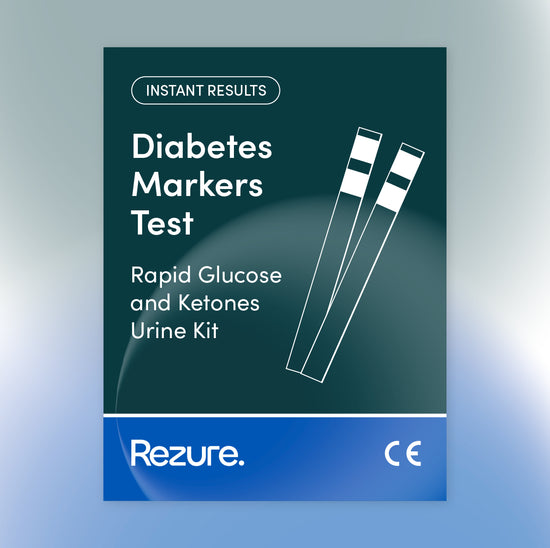
If diabetes risk is also relevant, a Diabetes Markers Indicator Home Test Kit checks urine for glucose and ketones. Our guide to early type 2 diabetes signs explains when symptoms and risk factors merit medical testing.

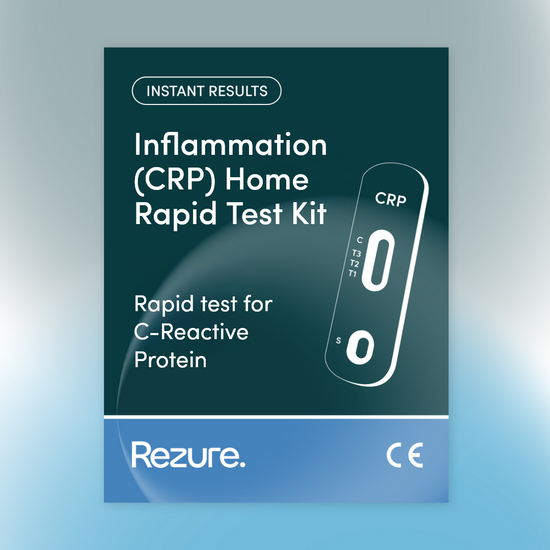
The Inflammation (CRP) Rapid Home Test Kit checks C-reactive protein, a marker of inflammation rather than FH or cholesterol. Read more about what a high CRP means.
The Liver Health Rapid Home Test checks bilirubin and urobilinogen in urine. It does not diagnose fatty liver disease. Our article on fatty liver and detox explains why fatty liver often appears alongside high cholesterol and type 2 diabetes.
What should you do with a strong family history?
Find out what happened, and at what age. Ask about heart attacks, coronary heart disease, cholesterol results, FH diagnoses and cholesterol-lowering treatment. Take those details to your GP and ask when you should have a full lipid profile.
You do not need to wait for symptoms. FH raises LDL from birth, and high cholesterol is usually silent. Earlier identification lets you discuss treatment and monitoring before years of raised cholesterol have accumulated.
The family story may begin as a few scraps of information. Once you add names, ages, and results, it can answer a practical question: is “I’ll check it later” really the right plan?