Donating blood for the first time: What to expect and why your type matters

The first surprise is how ordinary the room looks. There’s a donation chair, a health questionnaire, water and a table of snacks. Most of the appointment is made up of small, familiar steps.
Giving blood for the first time can be daunting, but the whole process is set up to be as painless and stress-free as possible.
This guide follows the NHS Blood Donation process in England. Scotland, Wales and Northern Ireland run separate services, so check your local service before booking.
Who can donate blood in the UK?
In England, a first-time donor normally needs to be aged 17 to 65, weigh between 50 kg and 158 kg, be generally fit and well, and have suitable veins.
Check these points first:
-
Age: First-time donors must usually be 17 to 65.
-
Weight: You must weigh at least 50 kg.
-
Health: Current illness, some conditions and certain medicines may affect eligibility.
-
History: Travel, tattoos, pregnancy, transfusions and recent sexual activity can lead to a deferral.
-
Timing: You’ll complete a health and lifestyle check at every appointment.
Use the official eligibility checker rather than relying on somebody else’s experience.
How should you prepare before giving blood?
Eat normally, drink plenty of non-alcoholic fluid and get a good night’s sleep. Don’t skip a meal. NHS Blood Donation advises eating a healthy meal, avoiding fatty foods and including iron-rich foods in your usual diet.
Wear sleeves that roll above your elbow. Review your eligibility if your health, medication or travel has changed. At the venue, staff will ask you to drink 500 ml of water before donating to reduce the chance of feeling faint.
What happens during your first blood donation?
The full visit usually takes about an hour. The donation itself commonly takes 5 to 10 minutes, during which 470 ml of blood is collected.

Here’s what to expect when giving blood:
-
Registration: You check in and complete a donation safety questionnaire.
-
Screening: A staff member reviews your health information privately.
-
Haemoglobin check: A finger-prick sample checks that your level is high enough.
-
Donation: A needle is placed in your arm and collection stops at 470 ml.
-
Recovery: You rest, drink and have a snack before leaving.
Most people feel a short scratch when the needle goes in, then little or no discomfort. Tell staff if you feel pain, faintness or nausea. The NHS donation process explains each stage.
Why does your blood type matter when donating?
Your blood type affects which patients can safely receive your red cells. The ABO groups are A, B, AB and O, and each is Rhesus D positive or negative. Rezure’s guide to how blood groups work explains the compatibility basics.
The O negative blood type is often called the universal donor type for red cells. Its red cells lack A, B and Rh D antigens, so they can be used when there isn’t time to establish a patient’s type. O positive is also in steady demand because it is the most common type. Rarer groups and subtypes may be needed for close matches.
In June 2026, NHS Blood and Transplant said regular O negative and B negative donor numbers had fallen by 5% since 2020. It reported about 107,000 regular O negative donors, 6,000 fewer than in 2020, and just over 20,000 regular B negative donors.
The Ro subtype is also under pressure. NHSBT said it supplied 3,600 Ro units a month against demand for 7,400, with O negative and B negative covering part of the gap. In late July 2026, its hospital stock status listed O and B D-negative red cells at Pre-Amber.
Do you need to know your blood type before donating?
No. The blood service will type and test your donation, then show your blood group in your online account or NHS Give Blood app.
The Blood Type (A, B, O, Rhesus) Rapid Home Test Kit uses a finger-prick sample to indicate your ABO group and Rhesus D status. Knowing in advance can help you understand why certain donation appeals apply to you.

A home result doesn’t replace the blood service’s testing or an official medical result. Staff won’t use it for transfusion decisions or to change your eligibility screening.
Can giving blood lower your iron levels?
Yes. Whole-blood donation removes red cells and some of the iron they contain. Before donation, staff check haemoglobin, not ferritin. In England, the minimum haemoglobin level is 125 g/L for women and 135 g/L for men. A passing result doesn’t directly measure stored iron.
Take extra care if you have heavy periods, follow a low-iron diet or have had low ferritin before. Rezure’s article on heavy periods and iron explains repeated blood loss, while iron and anaemia myths clears up common confusion.
The Iron Deficiency (Ferritin) Rapid Home Test Kit checks ferritin rather than haemoglobin. It doesn’t diagnose anaemia. Persistent fatigue, breathlessness, palpitations, dizziness or a low result needs medical follow-up. Rezure’s guide to persistent fatigue covers other causes.
Is donating blood a general health check?
No. The appointment checks if you can donate safely and if the donation is suitable for patients. It isn’t a replacement for routine healthcare or symptom investigation.
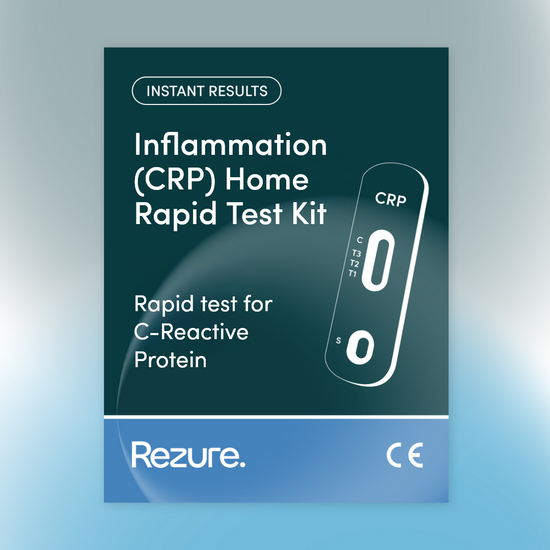
The Inflammation (CRP) Rapid Home Test Kit looks for raised CRP. The Total Cholesterol Rapid Home Blood Test Kit measures total cholesterol. Neither forms part of the standard pre-donation haemoglobin check.
For more context, read what a high CRP means and how cholesterol and inflammation relate to heart health. Don’t treat a successful donation as proof that unrelated symptoms are fine.
What should you do after giving blood?
Rest at the venue, have at least two drinks and eat a snack before leaving. Keep the pressure dressing on for around 30 minutes and the plaster on for six hours. Avoid heavy lifting with the donation arm, strenuous exercise and a hot bath for the rest of the day.

After you leave:
-
Drink: Keep replacing fluid.
-
Eat: Have regular meals, including iron-rich foods.
-
Pause: Sit or lie down if you feel faint.
-
Press: Apply firm pressure if the site starts bleeding.
-
Call: Contact the donor helpline if you become unwell or think your blood shouldn’t be used.
NHS Blood Donation says one donation can help save up to three lives.
You don’t need to arrive knowing your type or feeling completely calm. Check that you’re eligible, prepare properly and tell the team how you feel. Then comes the same chair, the same rolled-up sleeve and, finally, the snack table. The room still looks ordinary. What leaves it isn’t.