Can omeprazole or antibiotics affect an H. pylori test?

If you already take omeprazole each morning or are currently using antibiotics, there's a chance that the underlying reason behind your prescription has something to do with an H. pylori infection. That creates a bit of a timing problem: the medicine easing your symptoms may also make H. pylori harder to detect.
Yes, omeprazole and antibiotics can affect an H. pylori stool antigen test. They can suppress the bacteria enough to produce a false-negative result, where the test says negative even though infection is present.
This applies to first-time testing and post-treatment checks. Understanding how your medicine may impact your result lets you understand when testing could be helpful or misleading.
To learn more about H. pylori in general, read our guide to H. pylori and ulcers, which covers the infection and its symptoms.
Can omeprazole affect an H. pylori stool test?
Yes. Omeprazole is a proton pump inhibitor, usually shortened to PPI. It reduces stomach acid. Lansoprazole, esomeprazole, pantoprazole and rabeprazole are PPIs too.
PPIs can temporarily lower the amount of H. pylori, or its antigen, that a test can detect. NHS hospital laboratories therefore advise a two-week washout before a stool antigen test. Oxford Hospitals' test guide gives the same interval as Newcastle Hospitals guidance. This is test preparation, not a judgement on your prescription.
Why can a PPI cause an H. pylori false negative?
A stool antigen test looks for bacterial material in a sample. If a PPI suppresses H. pylori, less antigen may reach the stool. The test can then miss an infection it would have found under normal testing conditions.
In a controlled omeprazole study, 25 people with confirmed H. pylori took 20 mg daily. After 14 days, the stool test gave six false negatives. In another group taking 40 mg, it gave nine false negatives among 25 people. Two weeks after omeprazole stopped, all tested positive again.

The study was small and used one laboratory assay, so those figures are not a failure rate for every kit. They do show why timing belongs in any discussion of home-test accuracy.
How long should I wait after taking a PPI?
The usual interval is two full weeks after the last PPI dose before a stool antigen test. The NICE testing standard uses this timing.
Use this as a planning rule, not an instruction to stop prescribed medicine yourself.
Before choosing a test date, note:
- The exact medicine name, since not every indigestion remedy is a PPI.
- The dose and how often you take it.
- The date of your last dose, if a clinician has agreed to a pause.
- The symptoms the medicine controls.
A missed morning is not a two-week washout. If stopping causes severe symptoms, or the PPI protects you from complications, ask your GP or pharmacist to plan the test.
Do antibiotics before a stool test affect the result?
Yes. The usual interval is four weeks after finishing antibiotics. This applies even if they treated something unrelated, such as a chest, dental or urinary infection. The issue is their effect on bacteria, not why you took them.
The practical rule is:
- Leave two weeks after stopping a PPI, if a clinician agrees.
- Wait four weeks after any antibiotics.
- Check bismuth medicines separately; local NHS guidance uses a four-week gap.
- Count from the final dose, not the day the prescription began.

Don’t delay or cut short a prescribed antibiotic course to bring a test forward. Record the completion date, then rearrange it. Our guide to what causes stomach ulcers explains the wider causes and treatment.
Is testing after treatment different from initial testing?
Yes. An initial test asks if active H. pylori infection is present. A post-treatment test asks if treatment cleared it. Eradication therapy usually contains antibiotics plus acid suppression, so the later test needs careful timing.
The ACG treatment guideline says a test of cure should take place at least four weeks after antibiotics, with PPIs withheld for at least two weeks. UK BNF guidance says at least four weeks after treatment, ideally eight. Your clinician may choose a stool antigen or urea breath test.
For a post-treatment check:
- Finish the full treatment exactly as prescribed.
- Agree on any PPI pause with the clinician managing your care.
- Leave the required antibiotic and PPI intervals.
- Use the test method and timing they recommend.
An antibody blood test is a poor fit here because antibodies can stay positive for years after treatment. A stool antigen result looks for current bacterial antigen.
Do I need to stop every antacid or stomach medicine?
No blanket rule covers every product. A PPI, an H2-receptor antagonist and a simple antacid are different medicines. Bismuth compounds fall into another category.
Some guidance allows H2 blockers or antacids during a PPI washout. That does not make any substitute right for you. Instructions vary by medicine and test.
Show a pharmacist or clinician the packets, prescription list and test instructions. Ask what needs pausing, what you can use during the gap, and when to restart.
I take omeprazole every day. Can I still use a home H. pylori test?
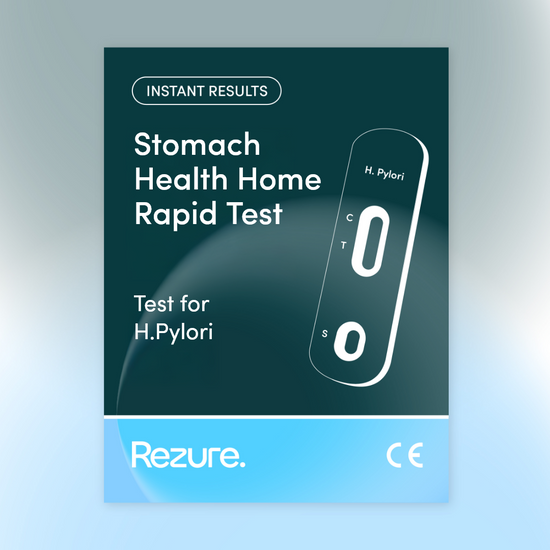
You may still be able to use one, with planned timing. The Stomach Health Home Rapid Test for H.Pylori sold by Rezure is a stool antigen test. Follow its instructions and the medication intervals agreed with a healthcare professional.

If you test while taking omeprazole, a negative result may be less dependable. If symptoms persist or infection is still suspected, ask about repeating it after a suitable washout or arranging another test.
Upper-abdominal pain, bloating or bowel changes don’t automatically mean H. pylori. Patterns overlap with IBS and similar conditions and coeliac disease symptoms.
What if a negative result does not explain my symptoms?
A negative H. pylori result answers one question. It does not identify every cause of indigestion, pain, nausea, bloating or fatigue.
Seek urgent help instead of waiting to retest if you vomit blood or material like coffee grounds, pass black sticky stools, or develop severe abdominal pain. The NHS ulcer guidance advises calling 999 or going to A&E for these symptoms.
For a non-urgent negative result with symptoms that continue, take the result, your medicine list and the dates of your last PPI and antibiotic doses to your GP.