Can finasteride for hair loss lower your PSA result?

A hair-loss tablet feels like a scalp thing. It sits in the bathroom cabinet next to shampoo, razors and all the other small acts of trying to keep yourself together.
Then a PSA test comes along, and suddenly that little tablet belongs in a prostate conversation.
Finasteride for hair loss can lower your PSA result. That matters because PSA is one of the blood markers used when checking prostate health, including possible prostate cancer.
The safety issue is not that finasteride makes prostate problems harmless. It is that it can make the number look lower than it otherwise would.
Can finasteride for hair loss really lower PSA?
Yes. The 1 mg dose used for male pattern hair loss can lower PSA enough to affect how the result should be read.
A key randomised controlled trial looked at 355 men aged 40 to 60 taking 1 mg finasteride for male-pattern hair loss over 48 weeks.
PSA fell by a median of 40% in men aged 40 to 49, and 50% in men aged 50 to 60, compared with no fall or a rise in the placebo groups.
The clearest numbers:
- Age 40 to 49: Median PSA fell by 40% after 48 weeks.
- Age 50 to 60: Median PSA fell by 50% after 48 weeks.
- Placebo: PSA did not fall in the same way.
It is easy to assume PSA changes only apply to the 5 mg finasteride dose used for enlarged prostate. They don’t.
If you are looking to understand prostate testing more broadly, read our guide to what PSA levels mean is the better place for general ranges. This piece focuses on the medication's effect.
Why does finasteride affect a prostate test?
Finasteride is a 5-alpha-reductase inhibitor. It blocks an enzyme that helps convert testosterone into dihydrotestosterone, or DHT. DHT is involved in causing male pattern hair loss, which is why the drug can slow shedding in some men.
The same hormone pathway also matters in the prostate. By lowering DHT activity, finasteride can reduce prostate stimulation and lower the amount of prostate-specific antigen measured in the blood.

PSA itself is made by prostate cells. Higher levels can come from cancer, an enlarged prostate, prostatitis and other non-cancer causes.
Finasteride changes the signal. It does not remove the need to read the signal properly.
Can finasteride make a PSA test falsely reassuring?
Potentially, yes.
Prostate Cancer UK says medicines such as finasteride and dutasteride can reduce PSA and give a false test result . The National Cancer Institute also notes that lower PSA cut-offs may be used in men taking finasteride or dutasteride because these drugs lower PSA.
That does not mean every lower PSA result is wrong. It means the result is incomplete without the medication history.
A PSA result should be interpreted alongside:
- Your age
- Symptoms
- Family history
- Ethnicity
- Medication
- Change over time
For wider context on signs and risk factors, see our guide to prostate symptoms and risk.
Should you double your PSA number if you take finasteride?
Don’t turn this into bathroom-cabinet maths.
The 1 mg finasteride study concluded that the existing adjustment used for men taking 5 mg finasteride should also apply to men taking 1 mg for hair loss. That adjustment is often described as multiplying PSA by two after the drug has had time to take effect.
But you should not self-adjust a PSA result and then self-reassure.
The safer version is simple: tell your GP, urologist, pharmacist, nurse or testing provider that you take finasteride, how much you take, and how long you have taken it. They can decide how to interpret your PSA level, and whether repeat testing, referral, MRI or other checks make sense.
What should you tell your GP before a PSA test?
Tell them you take finasteride before the test is interpreted, not after everyone has already relaxed about the number.

MedlinePlus advises people taking finasteride to tell their doctor and laboratory staff before any lab test. That advice fits PSA testing well.
Tell your clinician:
- The dose: For example, 1 mg for hair loss or 5 mg for prostate enlargement.
- The start date: A few weeks is different from a year.
- The pattern: Daily, missed doses, recent stopping or restarting.
- The format: Tablet, topical preparation, or another source.
- Any symptoms: Urinary changes, pain, blood in urine or semen, erectile changes, pelvic pain.
- Your risk factors: Family history, Black ethnicity, age, previous PSA results.
Other timing issues matter too. NHS PSA advice says to avoid ejaculation, cycling, heavy exercise and anal sex for 48 hours before a PSA test, as these can raise PSA and make the result less accurate.
It also says to wait 4 to 6 weeks after a urinary infection has cleared before testing.
That is the messy part. Finasteride may push PSA down. Infection or prostatitis may push it up. If pelvic pain or urinary symptoms are in the mix, our guide to how prostatitis can raise PSA is worth reading before you treat one number as the whole story.
Can you use a home PSA test while taking finasteride?
Yes, but treat it as screening information, not a diagnosis.
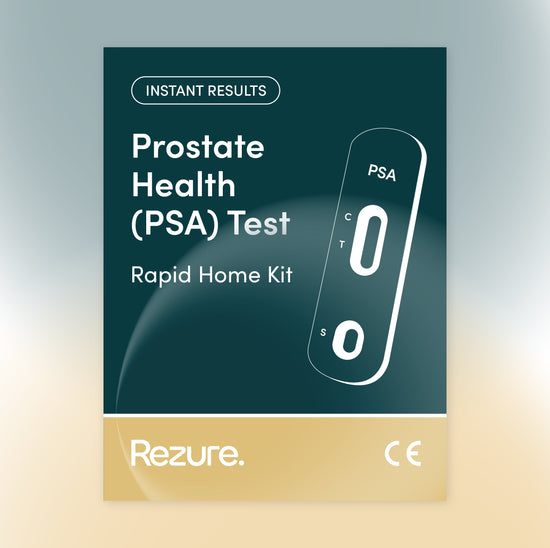
The Prostate Health (PSA) Rapid Home Test Kit Rezure sells uses a finger-prick blood sample and gives a threshold-style result in minutes. That can be a useful first check for some people.
But if you take finasteride, a lower or non-elevated result should not be read in isolation. The medication may lower PSA. Symptoms still matter. So does family history. So does a previous PSA result that has changed.
A home PSA test can start the conversation. It should not close it.
What else can affect PSA apart from finasteride?
PSA is sensitive to more than cancer. That is why PSA test accuracy depends on timing and context.
Common PSA confounders include:
- Prostatitis or urine infection
- Benign prostate enlargement
- Recent ejaculation
- Cycling or heavy exercise
- Recent prostate stimulation
- Recent bladder or prostate procedures
- 5-alpha-reductase inhibitors, including finasteride and dutasteride
If urinary symptoms are part of the picture, a broader look at urine dipstick markers may help you understand why clinicians often check urine as well as PSA. And if you notice blood in your urine, don’t sit on it because a PSA result looked fine.
That cabinet has more than one clue in it.
What safety concerns should men taking finasteride know about?
The PSA issue is one safety concern. It is not the only one.
The MHRA has strengthened warnings for finasteride and dutasteride, including risks of sexual dysfunction, depression and suicidal thoughts.

It says patients taking finasteride who experience depression or suicidal thoughts should stop treatment and seek medical advice, and that sexual side effects should be discussed with a healthcare professional.
Get medical advice if:
- You have urinary symptoms: Peeing more often, weak flow, urgency, night-time urination, pain or trouble starting.
- You see blood: In urine or semen.
- You have pelvic pain: Including pain in the lower back, hips, groin or rectal area.
- Your PSA rises: Even if it is still within a usual range for men not taking finasteride.
- You are at higher risk: For example, Black men or men with a close family history should discuss PSA testing earlier.
- Your mood changes: Depression or suicidal thoughts need prompt medical advice.
If the finasteride started because of hair loss, that still counts. A medicine taken for your hair can change a number used to judge your prostate. Put it on the medicine list before the PSA number is read.