What do PSA levels mean, and when should you worry?

A PSA result can look simple on the page. One number. One short label. Yet it often raises a long list of questions. What counts as normal? Does a higher result mean cancer? Can PSA be high without cancer?
That uncertainty is common, and it is exactly why PSA levels need careful explanation. PSA stands for prostate-specific antigen, a protein made by prostate cells. A prostate blood test measures how much of it is in your blood.
Higher readings can be linked to prostate cancer, but they can also happen with an enlarged prostate, a prostate infection, or prostatitis. That makes a PSA test for prostate cancer useful, but never definitive on its own.
What do PSA levels mean?
The clearest answer is this: they show how much PSA is in your blood at that moment. They don't, on their own, show why it is there.
Some PSA in the blood is normal. Levels often rise a little with age because the prostate tends to get bigger over time. A higher result can point to a prostate problem, but it does not tell you which one without more context.
That matters because many people hear “high PSA levels” and think “cancer”. Doctors definitely don't read it that simply. They look at the number, your age, symptoms, family history, ethnicity, medicines, and sometimes changes over time, rather than at a single isolated result.
What is a normal PSA level?
There is no single normal PSA level that fits everyone. Cancer Research UK says PSA levels by age matter, and gives age-based referral points that many clinicians use as a guide for men with symptoms:
-
Age 40 to 49: more than 2.5 ng/ml
-
Age 50 to 59: more than 3.5 ng/ml
-
Age 60 to 69: more than 4.5 ng/ml
-
Age 70 to 79: more than 6.5 ng/ml
Even so, that is not the same as saying anything below those numbers is automatically safe, or anything above them means cancer.
There is no single PSA reading considered normal for everybody, and many men have a PSA below 3 ng/ml, while some older men may have a level above 3 ng/ml that is still not due to cancer.
Does a high PSA mean prostate cancer?
No. A raised result can be a sign of cancer, which is why the test is used, but many raised results happen for other reasons. Many people with a raised PSA level don't have prostate cancer.

A raised prostate cancer test result can be linked to:
-
An enlarged prostate
-
A prostate infection
-
Prostatitis
-
Recent ejaculation
-
Vigorous exercise, especially cycling
-
Recent procedures affecting the prostate
So, can PSA be high without cancer?. Yes, it can, but other factors might be at play. In practice, that is one of the main limits of prostate cancer screening with PSA alone.
What causes PSA levels to rise?
The main causes fall into two groups: prostate conditions and temporary influences around the time of testing.
Prostate conditions include prostate cancer, benign enlargement, and inflammation or infection.
Temporary influences include ejaculation and exercise that leaves you out of breath, which the NHS advises avoiding for 48 hours before a PSA test because they can make the result less accurate.
A bigger prostate can also produce more PSA without cancer being present. That is one reason doctors sometimes look at PSA density, which compares PSA levels with prostate size.
Can you have prostate cancer with normal PSA?
Yes. This is one of the hardest parts of the whole subject. A normal-looking result does not rule prostate cancer out. Some men have prostate cancer even though their PSA is normal for their age.
Around 1 in 7 men with a normal PSA level may have prostate cancer, and around 1 in 50 may have a fast-growing cancer.
That does not make the test useless. It means you should not lean too hard on one number. If symptoms, family history, ethnicity, or a change over time point to concern, a “normal” prostate test still needs proper context. That is one reason PSA levels are often more useful as part of a pattern than as a one-off snapshot.
Should I get a prostate test?
For many people, this is the real question underneath all the others. You may want to think more seriously about a prostate health test if:
-
You are 50 or over
-
You have urinary symptoms
-
Your father or brother has had prostate cancer
-
You are Black or of mixed Black ethnicity
-
You have noticed a change over time, rather than one odd result
Risk is not spread evenly. 1 in 4 Black men will get prostate cancer, and it is strongly recommended that Black men over 45 speak to their GP about risk and PSA testing. The same kind of earlier conversation is advised for men aged 45 and over with a family history of prostate cancer.
When should you worry about PSA levels?
Worry is reasonable when a result is above the expected range for your age, when it keeps rising, or when it sits alongside symptoms such as trouble passing urine, urgency, poor flow, pain, or blood in urine or semen. A result can also matter more if you are in a higher-risk group.
A sensible response looks like this:
-
Check if anything temporary could have pushed the reading up
-
Speak to your GP or clinician rather than trying to interpret it alone
-
Ask how your age, symptoms, and risk factors change the meaning
-
Ask what the next step is, not just what the number is
What happens after a raised PSA result?
After a raised PSA result, it usually does not jump straight to a diagnosis. Your GP may review symptoms, examine the prostate, repeat the test if the circumstances were not ideal, or refer you to a specialist.

Specialist tests can include an MRI scan and biopsy. MRI is often used early because it helps show whether a biopsy is likely to be needed.
The usual pathway after referral looks like:
-
A review by a specialist
-
An MRI scan
-
A possible biopsy
-
Other scans if cancer is found and staging is needed
That follow-up can depend on the MRI result. In some people with a raised PSA and a low-risk MRI, PSA may be repeated after 3 to 6 months, with biopsy offered if suspicion remains strong.
Is there a role for a home prostate test?
A home prostate test can be useful for people who want an early, private first check before speaking to their GP.
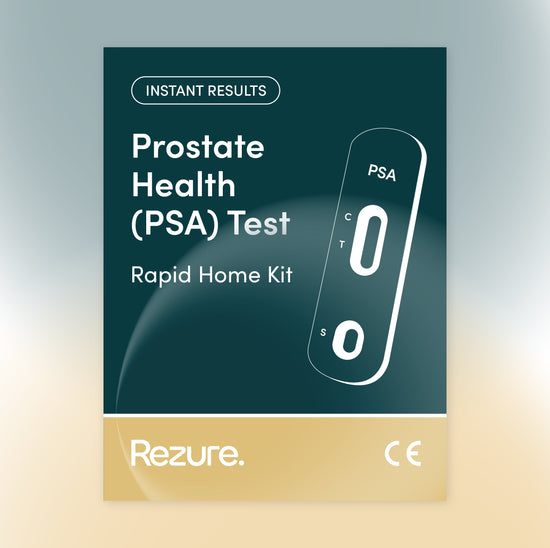
Rezure sells a Prostate Health (PSA) Rapid Home Test Kit designed for that kind of first-step screening at home, using a finger-prick blood sample. Results should still be treated as screening information, not a diagnosis.
That same broader view applies across men’s health. Someone thinking about a prostate cancer test may also be thinking about heart risk, fertility, or general midlife health.
In that context, related options on Rezure include the Mature Man Health Bundle and Well Man Bundle, the Total Cholesterol Rapid Home Blood Test, and the Sperm Count and Male Fertility Rapid Home Test.
Those are different questions, of course, but they share the same real-world space: trying to get a clearer picture before small worries turn into long delays.
If you want a broader primer on symptoms, risk factors, and timing, Rezure’s guide to Prostate health decoded: Signs, risks, and when to test is a useful companion read.
So what is the sensible takeaway?

PSA levels matter, but they don't tell the whole story on their own. A prostate blood test can help flag a possible problem early. It can also rise for reasons that aren't cancer, and it can miss some cancers. That is why the result should always be read alongside age, symptoms, risk factors, and follow-up tests where needed.
So, when should you worry about PSA levels? Take the result seriously if it is raised for your age, if it keeps rising, if you have symptoms, or if you are in a higher-risk group. Then focus on the next step. Speak to your GP or clinician, ask what the number may mean in your case, and find out what happens after a raised PSA result. That is usually the most useful way to approach a prostate cancer test.