How do saliva drug tests work? What they detect and accuracy explained

Saliva drug tests are a good choice when the question is straightforward, time is of the essence, and you want less fuss than comes with urine tests.
Has someone used a drug recently? Is a quick on-the-spot check more useful than a test with a longer look-back window? Oral drug tests, also called swab drug tests or a mouth swab drug test, are designed for that kind of situation.
Why do people use saliva drug tests in the first place?
These tests use oral fluid rather than urine. They are easy to administer, and they tend to be most useful for recent drug use rather than a longer history. Oral fluid collection can be carried out in different settings and doesn't need specialist collection facilities, which is one reason it is widely used for observed testing.
That practical point matters. A saliva sample can often be collected quickly, in full view, with less concern for privacy than urine.
That doesn't make saliva better in every case. It makes it useful for a different job. If the main concern is recent use, saliva drug tests can be a good fit. If the aim is to look further back, urine may be the stronger option.
How do saliva drug tests work?
The short answer is that they screen oral fluid for selected drugs or drug metabolites using an immunoassay strip built into the test device.
To break that down a little, you collect saliva with a swab or sponge, place the sample into the cassette or integrated collector, and wait for the result window to develop. These devices are set to react when a substance reaches or passes a defined cut-off level.

That means oral drug tests are screening tools. In home or informal use, they can give a fast indication of recent exposure. In workplace, forensic, or legal settings, a non-negative screen is usually followed by confirmatory laboratory testing with a more specific method. European workplace testing guidance makes this distinction clearly.
In practical terms, a mouth swab drug test usually follows this pattern:
-
Collect oral fluid from inside the mouth
-
Allow the sample to move across the test strip
-
Read the result after the stated waiting time
-
Treat any non-negative result as a screen, not a final laboratory diagnosis
That is also why it makes sense to follow the instructions closely. Recent food or drink consumption, smoking, or poor collection technique can affect sample quality.
What do saliva drug tests detect?
That depends on the panel. There is no single list that applies to every test on the market.
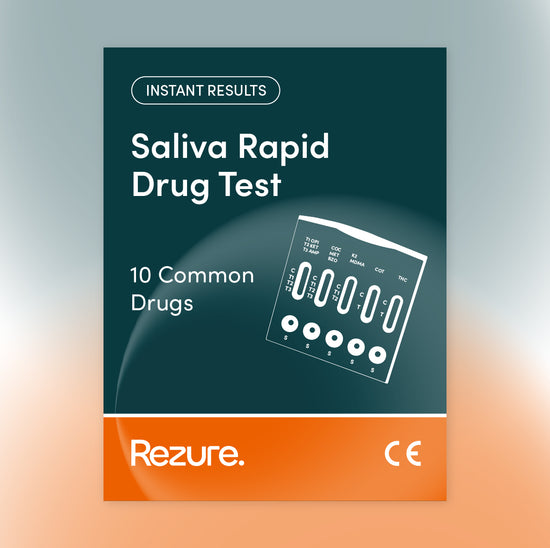
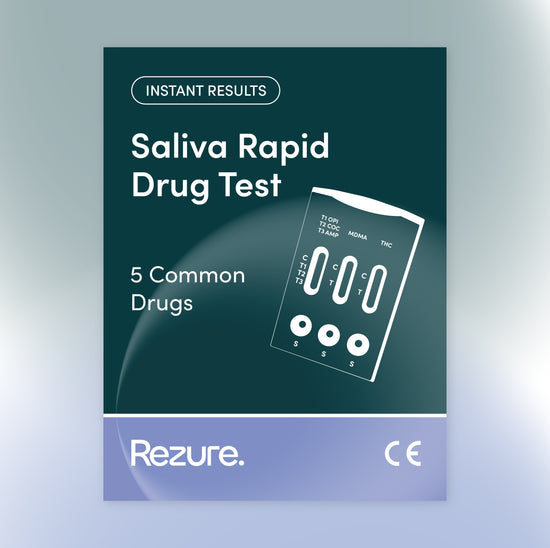
The Rapid Drug Test Kit for 5 Common Drugs (Saliva) that Rezure sells screens for amphetamines, cannabis, cocaine, MDMA, and opiates. The Rapid Drug Test Kit for 10 Common Drugs (Saliva), on the other hand, includes a broader panel, adding benzodiazepines, cotinine, ketamine, methamphetamine, and synthetic marijuana.
That means that it’s important to choose the right test for the drug you’re trying to identify. You should also confirm which drugs the test screens for before use.
Usually, they focus on drugs where recent use is the main issue. That is one reason oral fluid testing appears in workplaces, schools, treatment settings, and roadside screening discussions.
Common targets on saliva panels in the UK include:
-
Cannabis or THC
-
Cocaine
-
Amphetamines
-
Methamphetamine
-
Opiates
-
MDMA
-
Benzodiazepines
-
Ketamine
The exact list still depends on the test you choose. That is why product-specific wording matters more than broad claims about saliva drug tests as a category.
Can an oral drug test detect THC?
Yes, if THC is included on the panel.
Cannabis is one of the main reasons people ask about oral drug tests. That is because saliva testing is often associated with recent cannabis use rather than a long detection window. Reviews of oral fluid testing show that THC can be detected in oral fluid after use, though performance varies by device, collection method, cut-off, and timing.
That is an important limitation to keep in view. A negative result doesn't always mean no recent exposure. Timing matters a lot with THC, and different test formats don't behave in exactly the same way.
Does a saliva drug test detect alcohol?
Usually, no. At least, not unless alcohol is specifically included on the panel. If alcohol is the issue, you need a test designed for alcohol.
A similar point applies to nicotine. A standard saliva drug panel isn't the same thing as a nicotine test. If the concern is smoking or vaping exposure, the Vaping and Smoking (Nicotine) Rapid Test that Rezure sells is the more relevant route because it looks for cotinine, which is the main metabolite used in nicotine testing.
How long do saliva drug tests go back?
Usually, the detection window doesn’t go as far back as urine. In general, saliva drug test detection time is shorter because oral fluid is mainly used to spot recent use.

A general window of around 24 to 72 hours can be expected for most drugs, though actual windows vary by substance and situation.
Several factors can shift that window:
-
The drug itself
-
Dose and frequency of use
-
The cut-off level of the test
-
The time between use and sampling
-
The way the drug enters the body
That last point matters with smoked or vaped drugs, because residues in the mouth can affect early detection in oral fluid.
Are saliva drug tests accurate?
The broad answer is yes; they can be accurate screening tools when used properly and when the question matches the strengths of oral fluid testing. Accuracy still depends on the device, the drug, the cut-off, sample quality, and timing.
The strength of oral drug tests isn't that they solve every testing problem. It is that they do a specific job well. Their limits are just as important:
-
They usually don't go back as far as urine
-
Performance can vary by drug and by device
-
A non-negative screen isn't the same as a confirmed laboratory result
-
Poor collection can reduce reliability
Those points are standard good practice, not a criticism of saliva testing itself. They are part of using the right tool for the right question.
How are saliva drug tests different from urine drug tests?
The biggest differences between oral fluid and urine drug tests are the ease of use, the lack of privacy concerns, and, again, that time window.

That creates a straightforward split in use:
-
Saliva is often chosen for recent-use screening
-
Urine is often chosen for a longer look-back window
-
Saliva is easier to observe during collection
-
Urine can be the better fit when past use over hours to days is the main concern
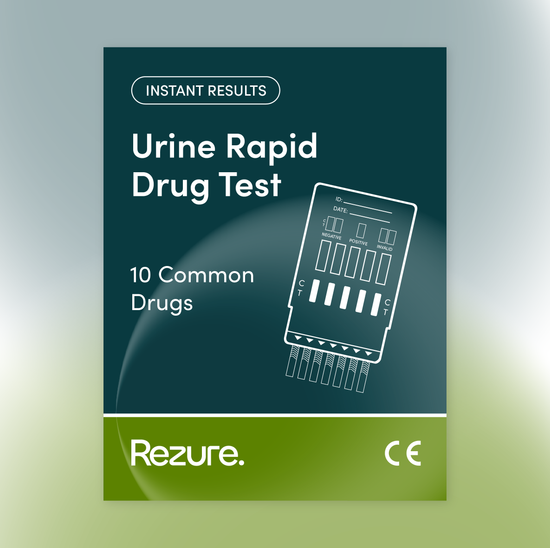
If you need the longer window that urine can offer, the Rapid Drug Test for 10 Common Drugs (Urine) and the Rapid Drug Test for 5 Common Drugs (Urine) that Rezure sells are the clearer comparison points.
If the concern is a single substance, the Cocaine Rapid Urine Drug Test Kit, the Cannabis (THC) Rapid Urine Drug Test Kit, and the Ketamine Rapid Urine Drug Test Kit give a more focused option.
What is the simplest way to think about saliva drug tests?
The clearest way to think about saliva drug tests is this: they are usually a recent-use screening tool. They are quick, simple to administer, and easier to observe than urine collection. That makes oral drug tests useful in real situations where speed and practicality matter.

They are not a catch-all test, and they don't replace confirmatory laboratory testing when the result carries serious consequences.
They are less invasive than urine collection and easier to supervise, which is why oral drug tests are often used for on-site screening. Urine still has the longer detection window for many drugs, so the better option depends on what you are actually trying to find out.
A mouth swab drug test is usually the better fit for recent use. A urine test is often the better fit for a longer look-back window.