Why is my hair shedding more than usual? 3 factors worth checking

Hair shedding more than before? The fear is real, and the cause can often be unclear. That’s why it helps to start with one simple point: some daily shedding is perfectly normal.
Most people lose around 50 to 100 hairs a day without noticing. Hair loss becomes more worth your attention when the shedding rate is clearly above your usual pattern. This might be when your parting looks wider, your ponytail feels thinner, or the change carries on for weeks rather than days.
Hair loss can have many causes, including stress, illness, weight loss and mineral deficiency. That’s why it makes sense to look at the whole picture rather than assume it is only cosmetic.
The Primary Care Dermatology Society’s guidance lists iron status, vitamin D status, and thyroid function among the basic investigations for hair loss.
That does not mean a low result automatically explains every hair change. Hair shedding is usually multi-causal, and pattern hair loss, hormonal shifts, illness, medication, scalp conditions, and ageing can all play a role.
Still, these three markers are useful because they are common, easy to check, and linked to broader symptoms you may have already noticed.
Could low iron be making my hair shed more?
It could. Iron deficiency is one recognised medical cause of temporary hair loss, and ferritin is the marker commonly used to estimate stored iron.
In people presenting with diffuse hair loss, low ferritin can help flag underlying iron deficiency, especially in telogen effluvium, which is the kind of shedding where more hairs shift into the resting phase and then fall out.
The British Association of Dermatologists says telogen effluvium often settles, but the shedding phase can last 3 to 6 months, and it can recur if an underlying cause, such as iron deficiency, is not treated.

The iron-and-hair story is useful, though it needs a careful read. The evidence is not perfectly tidy. Profound iron deficiency anaemia can cause diffuse hair loss, but the link between milder iron deficiency and chronic diffuse hair loss remains debated.
At the same time, a systematic review and meta-analysis of 10,029 participants found that women with non-scarring alopecia had lower average ferritin levels than women without hair loss.
A few practical signs make iron status more worth checking:
-
Heavier periods
-
Tiredness or shortness of breath
-
Dizziness or poor concentration
-
Recent dietary restriction or weight loss
-
A pattern of diffuse shedding across the scalp rather than a defined patch
Can thyroid problems cause dry hair or hair loss?
Yes, especially if the problem is significant or has been going on for a while.
Dry skin, dry hair and hair loss are among common symptoms of an underactive thyroid. The British Thyroid Foundation adds an important detail: severe and prolonged hypothyroidism and hyperthyroidism can cause diffuse hair loss across the whole scalp, while mild or short-lived thyroid problems are less likely to do so.
That pattern matters because thyroid-related hair changes often come with other clues. You are usually not dealing with the hair in isolation.

If your thyroid is underactive, your body’s metabolism slows. That can show up in the mirror and in daily life. Hair may feel drier, rougher or more brittle. You may also feel colder than usual, more tired, more foggy, or notice weight gain, constipation, low mood, or heavier periods.
Signs that make thyroid function more worth checking include:
-
Dry hair plus fatigue
-
Feeling cold when others do not
-
Constipation
-
Low mood or slowed thinking
-
Heavier or irregular periods
-
Hair thinning that seems general rather than patchy
A thyroid result does need context. A raised TSH can point towards an underactive thyroid, yet hair changes usually improve over time only when the underlying thyroid disorder is properly assessed and managed.
Does vitamin D affect hair health?
Possibly, yes, though this is the area where the science is more mixed. Vitamin D certainly has a role in skin and hair follicle biology.
A review in Dermatology and Therapy notes that vitamin D acts through the vitamin D receptor in hair-follicle keratinocytes, and that low vitamin D levels have been linked in several studies to alopecia areata.
The same review also notes that the data on telogen effluvium and female pattern hair loss are conflicting, and larger studies are still needed.
That is still useful clinically. A marker can be worth checking even when it is not the sole cause. The same review recommends screening for deficiency and correcting it in patients with hair loss and vitamin D deficiency.

Vitamin D also matters because low levels are common in the UK. Government figures say around 1 in 6 adults have vitamin D levels below recommendations, with higher rates in people who are housebound and in Black and South Asian communities.
In the UK, sunlight exposure is a major source of the vitamin, which is one reason levels often dip outside sunnier months.
Vitamin D may be more worth checking if you:
-
Spend little time outdoors
-
Cover most of your skin outdoors
-
Have darker skin
-
Are in winter or spring in the UK
-
Also have muscle weakness, bone pain or low mood
When is a home check useful, and when should I speak to a clinician?
A home check is useful when you want an early look at a few obvious markers that might help explain a change. It is practical when the shedding is new, diffuse, and not clearly explained by something temporary.
It can also help if you want a baseline before deciding what to discuss with a clinician.
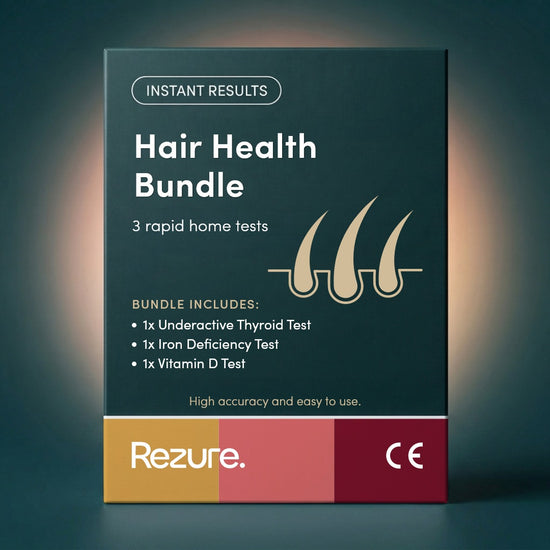
Rezure offers a Hair Health Bundle - 3 Rapid Tests for Iron, Thyroid & Vitamin D for exactly that purpose: a first step that gives you a view of key areas linked to hair vitality

Each test is supplied individually and used separately according to manufacturer instructions.
However, you should speak to a clinician promptly if:
-
Your hair loss is sudden or severe
-
You have bald patches, scalp pain or scalp inflammation
-
You have other strong symptoms such as marked fatigue, weight change, shortness of breath or very heavy periods
-
The shedding lasts longer than 6 months
What should I look at besides the hair itself?
The best clue is often the pattern around the shedding. Hair rarely changes in a vacuum. If the issue is linked to iron, thyroid, or vitamin D, you may notice broader symptoms before you connect them to your hair.

Useful questions to ask yourself include:
-
Has the shedding followed illness, stress, dieting or weight loss?
-
Is your hair also drier, more brittle or slower to recover?
-
Do you feel more tired, colder, weaker or more short of breath?
-
Have your periods changed?
-
Has the change built gradually over months?
This broader view matters because the same markers that affect hair can overlap with other wellness concerns. Fatigue is an obvious example. So are low mood, poor concentration, feeling cold, muscle weakness and heavier periods.
Rezure’s wider range reflects that overlap, with products and bundles that cover areas such as fatigue, digestive health, and urinary vitality rather than treating one symptom in isolation.
So why is my hair shedding more than usual?

Sometimes the answer is temporary stress on the body. Sometimes it is pattern hair loss. Sometimes it is a marker that sits in the background for months before the hair gives it away.
Iron status, thyroid function and vitamin D are worth checking because they are common, relevant, and tied to wider symptoms that often travel with hair changes. The link is strongest and most established for thyroid disease and significant iron deficiency.
Vitamin D is more nuanced, yet still worth considering, especially in the UK and especially when deficiency is plausible.
If your hair feels drier, thinner or less like your normal hair, a quick check of these three factors could give you a clearer starting point.