Could my iron levels be low if my haemoglobin level is high enough to donate blood?

Yes. Your haemoglobin can be high enough to donate blood even if your iron stores are low.
A haemoglobin (Hb) test is the finger-prick test taken when you attend to donate blood in England. It’s a measure of the concentration of haemoglobin, the protein in red blood cells that transports oxygen around the body, in your blood. Your body needs iron to make haemoglobin.
For whole blood donation, NHS Blood and Transplant requires a haemoglobin level of at least:
- 125 grams per litre (g/L) for women
- 135 g/L for men
These cut-offs allow for the drop in haemoglobin after you give blood. In some cases, NHSBT may take a blood sample from your arm to check your haemoglobin level again before deciding if you can donate.
A ferritin blood test measures ferritin in your blood and gives an indication of how much iron is stored in your body. Levels below 15 micrograms per litre (µg/L) of ferritin can be a sign that your iron stores are low.
How common are low iron stores in blood donors?
Nearly a quarter of women and around one in twelve men who had their ferritin measured in the INTERVAL blood donation study had low iron stores (ferritin levels below 15 µg/L). The researchers measured ferritin in more than 42,000 adults attending 25 blood donation centres in England who were eligible to donate blood that day.
What happens to the iron in my body after I’ve donated blood?
When you give whole blood, around 470 ml is removed. This includes plasma (the liquid part of the blood) and red blood cells which contain iron. The fluid in blood can be replaced relatively quickly, and this is why you’re encouraged to have a drink after donating blood. It takes longer to replace red blood cells.
In normal circumstances, most of the iron in red blood cells that die at the end of their lifespan is re-used by your body. This isn’t possible for red blood cells that are removed when you give blood. When your bone marrow produces new red blood cells to replace those that have been donated, it uses some of the iron stored in your body, and your body will also absorb more iron from the food you eat.
If you give blood regularly, your iron stores can fall over several donations if you donate again before your body has had time to replace the iron you’ve lost. In the INTERVAL blood donation study, which took place in England, people who were asked to donate blood more frequently had lower average ferritin levels two years after starting the study than people who were asked to attend appointments according to the standard blood donation intervals.
How long will it take for my body to replace the iron it’s lost after donating blood?
According to NHS Blood and Transplant, for most people it takes between 6 and 12 weeks for their haemoglobin levels to return to normal levels after donating blood. In England, the minimum gap between whole blood donations is 12 weeks for men and 16 weeks for women.
These timeframes between donations are in place to allow your body time to replace the red blood cells you’ve lost. However, this doesn’t necessarily mean that your iron stores will have recovered. A ferritin blood test can give you an indication of how much iron you have in reserve.
In a US study of 215 adults, researchers monitored ferritin levels in participants for 24 weeks after they donated whole blood and found that two-thirds (67%) of participants who didn’t take iron supplements still had lower ferritin at 24 weeks than before they donated blood.
This means their ferritin levels hadn’t returned to where they were before donating blood. Some could still have been within the normal range at 24 weeks. Someone who had low ferritin before donating could return to their pre-donation level and still have low ferritin.
What ferritin levels would a home ferritin blood test show me between donations?
If you’re comparing results from different blood tests, check what each test measured. The routine NHS Blood Donation finger-prick checks haemoglobin. A home or laboratory ferritin test checks ferritin.
| Test | What the result tells you |
|---|---|
| Haemoglobin check before donation | The donor team uses it to decide if your haemoglobin is high enough to give blood that day. |
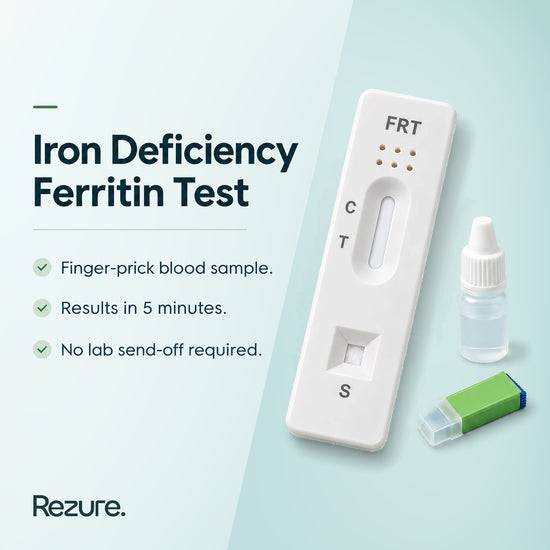
| Rezure’s home ferritin test | The kit checks for ferritin below 30 µg/L using a finger-prick blood sample. You won’t get an exact figure. |
| Laboratory ferritin blood test | You get a number. Your GP can compare it with earlier readings and look at it alongside your symptoms and haemoglobin level. |
Ferritin levels vary from person to person and can fluctuate over time. Ferritin levels can change for lots of reasons, including:
- iron deficiency
- illness or infection
- inflammation
- pregnancy
- liver disease
- regularly donating blood
Ferritin levels can also change if you're taking iron tablets. It's important to remember that ferritin levels are just one marker of iron levels in the body.

Ferritin test results
A ferritin test is used to measure the amount of ferritin in your blood. Ferritin is a protein that stores iron in your body.
There are different ferritin tests available. Some ferritin tests just tell you if your level is below a certain level (for example, the Rezure ferritin test screens for ferritin below 30 µg/L). Others provide a ferritin level (for example, a ferritin test done by your GP will provide a number).
Say your ferritin rose from 12 to 27 µg/L between two checks. Both values fall below the home kit’s cut-off, so the results could look identical. A laboratory test could show how much your level had risen.
If your ferritin level was previously measured by your GP and you'd like to check if your level has changed since, you could ask your GP to repeat the test. This can be helpful to see how your ferritin level changes over time or if you want to check how well your iron tablets are working, for example.
If your ferritin level is low
Ferritin levels below 30 µg/L are generally considered low. But ferritin levels can vary and it's best to discuss your ferritin level with a doctor.
The INTERVAL study counted levels below 15 µg/L. A reading of 20 µg/L would fall below the home kit’s cut-off but above the study’s. That’s why the study figures can’t tell you how many donors would get a low result on this kit.
If you've had a ferritin test and think your level may be low, it's a good idea to speak to your GP. Before your appointment, jot down any questions you'd like to ask and bring along any information that could be helpful, for example:
- your ferritin test result (if you used a ferritin test that doesn't provide a level, let your GP know which test you used so they know what the result refers to)
- when you last donated blood and how often you've donated in the last year
- any symptoms you're having (for example, feeling constantly tired), and when they started
- any other blood loss, including heavier or longer periods than usual.

Your GP may recommend tests to check your iron stores and look for anaemia, such as:
- a full blood count (to measure your haemoglobin level and other things)
- another ferritin test (to double-check your ferritin level or get an idea of how it's changed since your last test).
Depending on your ferritin and haemoglobin levels, symptoms and blood donation history, your GP may recommend further tests to rule out other causes of low ferritin.
If you're due to donate blood soon
If you're due to donate blood soon, it's a good idea to let the donor team know about your ferritin result before you arrive, as they'll be able to advise you on what to do next with your donation appointment. If you donate blood in England you can call NHS Blood Donation on 0300 123 23 23.
Don't put off seeing your GP about low ferritin levels or symptoms, and don't wait until your next blood donation appointment to raise any concerns. If you’re still feeling tired, mention it even if your home ferritin result was normal.